
How to stop procrastinating when studying
To stop procrastinating when studying, make the first step so small it is hard to refuse, such as answering three questions, start at a fixed time rather than when you feel ready, and remove the easy distractions before you begin. Procrastination is usually avoidance of an uncomfortable feeling, so lowering the cost of starting matters more than willpower.
What most advice leaves out
Procrastination is often treated as laziness or bad time management, but most students who procrastinate care a lot about the outcome. The task feels big, vague or threatening, so the mind reaches for something that feels better right now. That is why making a better timetable rarely fixes it. What helps is making the task smaller and clearer, making starting automatic, and getting a quick sense of progress, so the uncomfortable feeling shrinks once you are moving.
Step by step
- 1
Name the smallest next step
Not "revise physics" but "open the past paper and answer question 1". A tiny, concrete step is much easier to start than a large, vague one.
- 2
Set a start time, not a mood
Decide in advance: "At 10am I open my notes." Waiting until you feel motivated usually means waiting a long time. Motivation often arrives after you start.
- 3
Commit to just a few minutes
Tell yourself you only have to work for ten minutes, and you are allowed to stop after that. Usually you will carry on, and if not, you still did ten minutes.
- 4
Remove the easy escapes
Phone in another room, distracting tabs closed, notes and materials ready the night before. Make starting easier than not starting.
- 5
Notice the feeling, then begin anyway
If you feel dread or boredom, name it: "I am worried this topic is too hard." Then do the tiny step. The feeling usually fades once you have something on the page.
- 6
Keep a visible record
Tick off each session you complete. Seeing a run of finished sessions makes it easier to keep going than an empty page of plans.
Common mistakes
- Waiting to feel motivated before starting.
- Making the first task huge, like "learn the whole module", so it feels impossible to begin.
- Responding to a lost day by planning an even bigger catch-up day, which is even harder to start.
Practise it with Migo AI Students
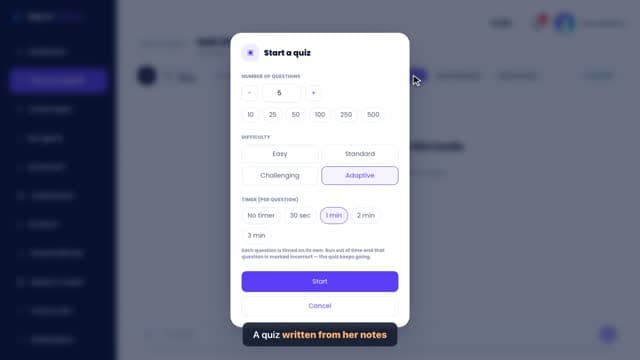
Migo can make the first step small. Choose Guided journey when you start a session and Migo breaks your goal into a step-by-step plan of short tasks you tick off, with the next task shown at the top. If even that feels like too much, a single Quiz Mode set or a quick Flashcards round from your study agent is a few minutes of work with a clear end. Your dashboard also shows a daily streak if you like a visible record. All study modes are free.
Questions
Why do I procrastinate even when I care about my exams?
Caring about the result can make the task feel more threatening, so avoiding it gives short-term relief. Making the first step smaller and more concrete reduces that feeling.
What if I procrastinate because I do not understand the topic?
Then the real first step is getting unstuck, not studying harder. Ask a tutor, a classmate or a study tool to explain the part you do not get, then start with easy questions to build up.
I lost a whole day to procrastinating. What now?
Do not try to make it all back tomorrow with a huge plan. Pick one small task for the next session, do it at a set time, and let a few normal days rebuild the habit. Then quietly move the missed topics into next week’s plan.
Related guides
- How to concentrate while studyingTo concentrate while studying, give each session one specific task, remove your phone from the room, work in a fixed block with a planned break, and study actively by answering questions or explaining ideas rather than rereading. Passive reading is the easiest thing for the mind to wander away from.
- Pomodoro technique for studyingThe Pomodoro technique is a time-management method where you work on one task for a set block, traditionally 25 minutes, then take a short break of about five minutes, and take a longer break after every four blocks. For studying, it works best when each block has a specific, active task.
- How to make a study timetable for examsTo make a study timetable for exams, list every topic for each exam, rank them by how weak you are and how much they are worth, then put specific topics into the free time you actually have, with regular review sessions and buffer time. Revisit the timetable each week and change it based on what your practice shows.
General study advice. Follow your own course’s guidance and your institution’s rules on assessment and AI use.