
How to concentrate while studying
To concentrate while studying, give each session one specific task, remove your phone from the room, work in a fixed block with a planned break, and study actively by answering questions or explaining ideas rather than rereading. Passive reading is the easiest thing for the mind to wander away from.
What most advice leaves out
Most advice on concentration is about willpower and environment: quiet room, good light, no phone. Those help, but they skip the bigger cause. Concentration usually breaks when the task itself is vague or passive. "Revise biology" gives your attention nothing to hold on to, and reading a page you half-know lets your mind drift while your eyes keep moving. A session built around a clear, active task, such as answering ten questions on one topic, keeps your brain busy with something that needs it.
Step by step
- 1
Decide the task before you sit down
Write one line: what you will have done by the end. "Answer the past paper questions on enzymes" is a task. "Do some chemistry" is not. A clear finish line makes it easier to keep going and to notice when you have drifted.
- 2
Put the phone in another room
Silent mode is not enough, because the phone on the desk still pulls at your attention. If you need it for study apps, turn on a focus setting that blocks everything else for the session.
- 3
Work in a fixed block
Choose a length you can actually hold, often somewhere between 25 and 50 minutes, and decide the break before you start. Knowing a break is coming makes it easier to stay on task until it arrives.
- 4
Make the work active
Answer questions, explain the topic out loud, draw a diagram from memory or do problems. Active work needs your attention to happen at all, so it is much harder to do on autopilot than reading.
- 5
Park stray thoughts
Keep a scrap of paper next to you. When a worry or a to-do pops up, write it down in a few words and go back to the task. You can deal with the list in your break.
- 6
Review and reset
At the end of the block, check whether you hit the task you set. If you drifted, notice when and why, and adjust the next session: a shorter block, an easier first step, a different room.
Common mistakes
- Starting a session with a vague goal like "revise" and no clear end point.
- Keeping the phone face-down on the desk and assuming that counts as putting it away.
- Choosing rereading and highlighting, which are the easiest methods to do while not really paying attention.
Practise it with Migo AI Students
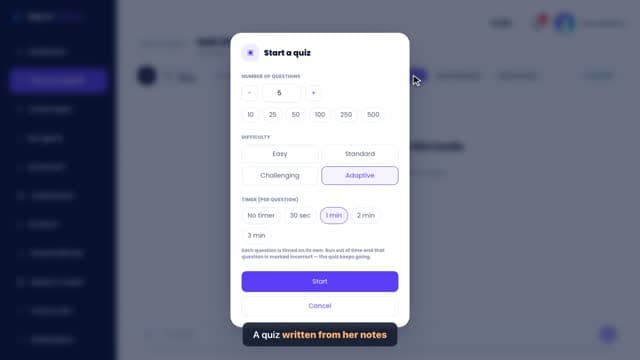
Migo gives each block an active task. Quiz Mode runs a timed question set from your study agent’s sources, which is a clear unit of work with a finish line and a score at the end. Study Document shows one page of your PDF or slides at a time beside Migo, so you can work through a lecture page by page and ask for a quick quiz on each page before moving on. When you get stuck mid-session, Chat Tutor explains the idea step by step so you do not lose the thread searching elsewhere. All three are free study modes.
Questions
Is it better to study with music?
It depends on you and the task. Many students find music with lyrics distracting for reading or writing, while quiet instrumental music or background noise can help block out a noisy room. Try a session with and without it and compare how much you actually got done.
Why can I focus on games but not on studying?
Games give constant feedback and clear goals. You can borrow that for studying: set a clear target for each session and use methods that give quick feedback, such as timed questions where you see your score.
How long can I realistically concentrate for?
It varies by person, time of day and how tired you are. Rather than chasing a number, find the block length you can hold without drifting, then build it up slowly.
Related guides
- Pomodoro technique for studyingThe Pomodoro technique is a time-management method where you work on one task for a set block, traditionally 25 minutes, then take a short break of about five minutes, and take a longer break after every four blocks. For studying, it works best when each block has a specific, active task.
- How to stop procrastinating when studyingTo stop procrastinating when studying, make the first step so small it is hard to refuse, such as answering three questions, start at a fixed time rather than when you feel ready, and remove the easy distractions before you begin. Procrastination is usually avoidance of an uncomfortable feeling, so lowering the cost of starting matters more than willpower.
- How to study for long hoursTo study for long hours, split the day into focused blocks with real breaks, switch between different kinds of tasks and topics, do the hardest work when you are most alert, and protect sleep, food and movement. Long hours only help if the time stays productive, so stop when your practice shows you are no longer taking things in.
- What is active recall?Active recall is studying by retrieving information from memory, for example by answering questions with your notes closed, rather than by reading the information again. Each act of retrieval strengthens the memory and shows you what you have not learned yet.
General study advice. Follow your own course’s guidance and your institution’s rules on assessment and AI use.