
How to revise over Christmas without burning out
To revise over Christmas without burning out, plan your days off before you plan your study, keep working days to a few short, active sessions, stop at a set time each day and keep your sleep regular. The aim is steady work you can repeat, not the longest day you can survive once.
What most advice leaves out
Advice about burnout usually says "take breaks" and stops there. The harder problem over Christmas is guilt. You arrive tired from term, exams are close, and everyone else is resting, so every hour off feels stolen and every hour of study feels like missing out. Half-working all day in that state, notes open on the sofa while the family watches a film, is the most tiring option of all. You get neither the revision nor the rest. Clear edges fix this: when you are working, you are properly working, and when you have stopped, you have stopped and nobody, including you, expects more.
Step by step
- 1
Take the first day or two off
You have just finished a term. A day or two of real rest at the start is not lost time. It is what makes the working days that follow possible.
- 2
Decide your days off in advance
Mark the days that belong to family, friends, travel or nothing at all. Tell the people you live with which days those are and which mornings you will be studying, so nobody is guessing.
- 3
Work in the morning, stop at a set time
Do your revision in one part of the day, for most people the morning, and choose a finish time before you start. When it arrives, stop, even mid-topic. Write one line saying where to pick up tomorrow.
- 4
Keep sessions short and active
Use blocks of 25 to 50 minutes with a break between them, and spend them answering questions, explaining from memory or doing past paper questions. Active work gets more done in a shorter day than rereading, which is what lets you stop early.
- 5
Keep sleep, food and daylight ordinary
Late nights and long lie-ins are part of the holidays, but try to keep your sleep roughly regular on working days, eat properly and get outside once a day. If tiredness or low mood does not lift with rest, talk to your GP or your college or university support service.
- 6
Check the plan once a week
At the end of each week, look at what you did, not what you hoped to do. If the plan was too heavy, cut topics you already know. Do not answer a heavy week by adding hours to the next one.
Common mistakes
- Half-revising all day in front of the television instead of two focused hours and a free afternoon.
- Comparing your hours with what other people post online.
- Cutting sleep to catch up, which makes the next day’s revision worse.
- Treating a planned day off as a failure and "making up for it" with a twelve-hour day.
Practise it with Migo AI Students
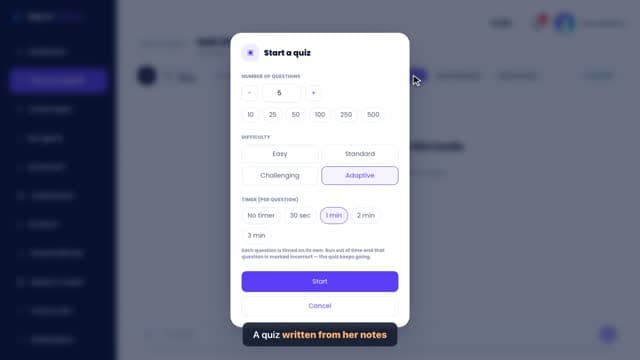
Migo is useful for keeping working days short. A Quiz Mode set written from your own notes is a few minutes of active revision with a clear end, and the reason is shown for every answer, so you find out what you do not know without rereading a chapter. Flashcards suit a ten-minute session on a busy day, and Chat Tutor can explain a topic you got wrong, citing the file and page from your notes. It does not plan your days off or tell you when to stop; that part is yours. Every study mode is on the free plan, with up to 10 study messages and 15 quiz or exam questions a day. Student Pro removes the daily limits.
Questions
Is it OK to take a whole week off over Christmas?
It depends on how close your exams are and how much you have already covered. If your first exam is in early January, a full week off leaves very little time. A few planned days off with steady work between them usually suits January exams better.
How do I stop feeling guilty when I am not revising?
Decide in advance when you are working and when you are not, and write it down. Guilt is strongest when the plan is vague. If today is a planned day off, resting is you following the plan.
What are the signs I am doing too much?
Reading the same page several times without taking it in, trouble sleeping, dreading the desk, and getting worse at questions you could do last week. If you notice these, take a full day off and shorten the next few days.
What should I do if I feel overwhelmed?
Stop for the day, tell someone you trust, and cut tomorrow down to one small task. If the feeling does not ease, speak to your GP or your institution’s student support or wellbeing service.
Related guides
- Christmas break revision timetable for January exams (with rest days)Build a Christmas revision timetable by marking your rest days first, counting the working days that are left before your first January exam, and giving each working day two or three specific topics with a short self-test at the end. Keep at least one spare day a week for the topics that overrun.
- How many hours a day should I revise over the Christmas holidays?There is no correct number of hours. Work yours out: count the topic sessions you need before your first exam, divide by the days you will really work, and check that the answer is something you can keep up. For many students that comes to a few focused hours on working days, with whole days off in between.
- How to study for long hoursTo study for long hours, split the day into focused blocks with real breaks, switch between different kinds of tasks and topics, do the hardest work when you are most alert, and protect sleep, food and movement. Long hours only help if the time stays productive, so stop when your practice shows you are no longer taking things in.
- Pomodoro technique for studyingThe Pomodoro technique is a time-management method where you work on one task for a set block, traditionally 25 minutes, then take a short break of about five minutes, and take a longer break after every four blocks. For studying, it works best when each block has a specific, active task.
General study advice. Follow your own course’s guidance and your institution’s rules on assessment and AI use.