
How many hours a day should I revise over the Christmas holidays?
There is no correct number of hours. Work yours out: count the topic sessions you need before your first exam, divide by the days you will really work, and check that the answer is something you can keep up. For many students that comes to a few focused hours on working days, with whole days off in between.
What most advice leaves out
This question usually comes from comparing yourself with someone who says they do eight or ten hours a day. Hours are a poor measure. Two hours of answering questions from memory can cover more than six hours of rereading with a phone on the desk, and nobody online reports how much of their ten hours was focused. The honest way to get a number is to start from the work, not the clock: how many topics you have, how many sessions each one needs, and how many days you actually have once the days off are taken out. That gives a figure that belongs to your exams rather than to someone else’s.
Step by step
- 1
Count the topic sessions you need
List the topics for your January exams. Give each weak topic two sessions and each of the others one, plus one or two timed papers per exam. As an example, that might come to 40 sessions.
- 2
Count your real working days
Take the days in your break and remove the days off. A 16-day break with four days off leaves 12 working days.
- 3
Divide, then turn sessions into hours
In the example, 40 sessions over 12 days is three or four sessions a day. At about 45 minutes each, that is roughly two and a half hours of focused work a day. Your own numbers will be different; the method is the point.
- 4
Check the answer against real life
If the sum gives a number you could not keep up for the whole break, do not just accept it. Cut sessions on topics you already know, or start a few days earlier. Do not take the difference out of your sleep.
- 5
Count focused time only
Time with your notes open is not the same as time working. Count only the blocks where you were answering questions, writing from memory or doing problems. Most people find the honest total is lower than they thought, and that it is enough.
- 6
Review after three days
After three working days, look at how many sessions you really completed. Use that figure, not the plan, to reset the rest of the break.
Common mistakes
- Picking a number because someone else uses it, instead of working it out from your own topics and days.
- Counting hours at the desk rather than focused sessions completed.
- Planning the same hours for every day of the break, including Christmas Day and New Year’s Eve.
- Adding hours when you fall behind instead of cutting low-value topics.
Practise it with Migo AI Students
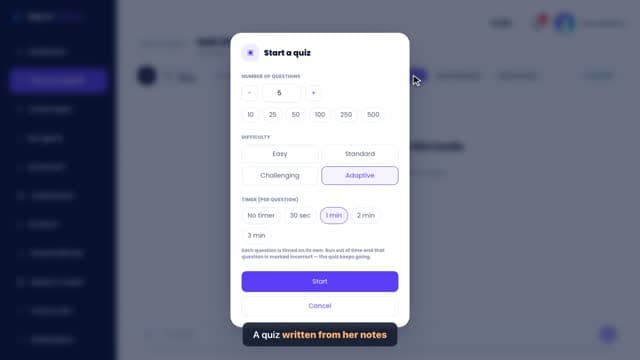
Migo can help you decide where the hours should go, which matters more than how many there are. Exam Simulator runs a timed mixed session from your study agent and gives a weak-topic report, so you can see which topics need two sessions and which need one. Quiz Mode can then quiz you on just the weak topics, and a Guided journey breaks a goal into tasks you tick off, which is an easy way to count sessions done rather than hours sat. Migo does not tell you how many hours to study. Every study mode is on the free plan, with up to 10 study messages and 15 quiz or exam questions a day. Student Pro removes the daily limits.
Questions
Is two hours a day enough over Christmas?
It can be, if the two hours are focused and you started with enough working days. Run the sum for your own topics. If two hours a day covers your sessions, it is enough; if not, add a session on some days or start earlier.
How many hours should I revise for GCSEs or A levels over Christmas?
There is no official figure, and schools give different advice. Ask your teachers what they suggest for your mocks, then use the same sum: topic sessions needed, divided by working days. A level students usually have more content per subject, so the sum often gives a higher number.
Is it better to revise in the morning or the evening?
Use the time of day when you concentrate best and are least likely to be interrupted. Over Christmas that is often the morning, because afternoons and evenings fill up with other people’s plans.
Should I revise every day of the holidays?
No. Planned days off make the working days easier to keep. Leaving out a few days and working steadily on the rest is a sounder plan than aiming for every day and stopping after a week.
Related guides
- Christmas break revision timetable for January exams (with rest days)Build a Christmas revision timetable by marking your rest days first, counting the working days that are left before your first January exam, and giving each working day two or three specific topics with a short self-test at the end. Keep at least one spare day a week for the topics that overrun.
- How to revise over Christmas without burning outTo revise over Christmas without burning out, plan your days off before you plan your study, keep working days to a few short, active sessions, stop at a set time each day and keep your sleep regular. The aim is steady work you can repeat, not the longest day you can survive once.
- How to study for long hoursTo study for long hours, split the day into focused blocks with real breaks, switch between different kinds of tasks and topics, do the hardest work when you are most alert, and protect sleep, food and movement. Long hours only help if the time stays productive, so stop when your practice shows you are no longer taking things in.
- How to concentrate while studyingTo concentrate while studying, give each session one specific task, remove your phone from the room, work in a fixed block with a planned break, and study actively by answering questions or explaining ideas rather than rereading. Passive reading is the easiest thing for the mind to wander away from.
General study advice. Follow your own course’s guidance and your institution’s rules on assessment and AI use.