
January mock exams: a two-week revision plan
With two weeks before January mocks, spend the first two days finding your weak topics, the next week working through them in short blocks with a self-test each day, and the last four or five days on timed papers and fixing what they show. Keep one full day off in each week.
What most advice leaves out
Mocks are practice, and that changes what a good plan looks like. The useful result of a mock is not only the grade but the list of things it shows you cannot yet do, months before the real exam. Students often waste the two weeks in one of two ways: treating mocks as nothing and doing no revision, so the result tells them only that they did not revise, or treating them as finals and trying to cover everything, so nothing is covered well. A two-week plan aimed at your weakest topics gives you a result you can actually use afterwards.
Step by step
- 1
Days 1 and 2: find out where you are
Get the mock timetable and the topic list for each paper from your teachers. Then do a short past paper section or a mixed quiz for each subject, without notes. Mark it and sort every topic into weak, shaky or confident.
- 2
Days 3 to 6: weak topics first
Give each day two or three weak topics from different subjects. For each one, relearn the idea briefly, then answer questions on it from memory. End the day with a ten-minute quiz on that day’s topics.
- 3
Day 7: day off
Take the whole day off. If your two weeks include Christmas Day or New Year’s Day, move the day off to fit. The plan is 14 days with two of them free, in whatever order your holidays need.
- 4
Days 8 and 9: shaky topics and second visits
Work through the shaky topics the same way, and return to the weak topics from days 3 to 6 with a few questions each. The second visit is where they start to stick.
- 5
Days 10 to 12: timed papers
Do one timed paper or timed section a day under exam conditions, starting with the subject whose mock comes first. Mark it with the mark scheme and write down every lost mark and why you lost it.
- 6
Day 13: fix what the papers showed
Use the list of lost marks. Fix the common ones first: a method you got wrong twice, a definition you could not give, a question type you ran out of time on.
- 7
Day 14: light review and an early night
Read your summary sheets, do a few easy questions for the first mock, pack your bag and stop early. Do not start a new topic the night before.
Common mistakes
- Revising the subjects you like and leaving the weak ones for "later in the fortnight".
- Doing timed papers without marking them properly, so the same mistakes come back in the mock.
- Trying to cover every topic in every subject equally in 14 days.
- Working all 14 days with no day off and arriving at the first mock already tired.
Practise it with Migo AI Students
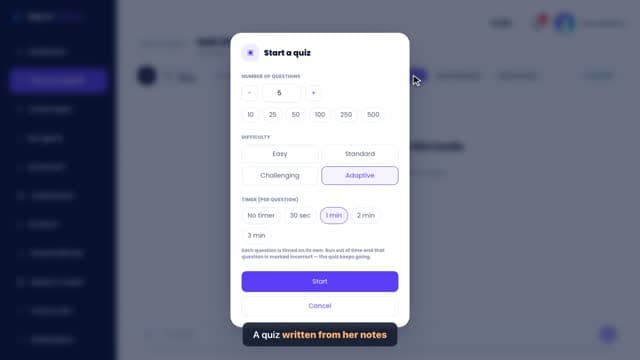
Build a study agent from your own notes or use one for your subject, then use Exam Simulator on days 1 and 2 for a timed mixed session: it gives a weak-topic report you can sort your topics from. Quiz Mode handles the daily ten-minute check and can quiz you on just the weak topics, with the reason shown for every answer. When a paper exposes something you do not understand, Chat Tutor explains it step by step from your notes. Migo is not your exam board: use your school’s past papers and mark schemes for the timed papers on days 10 to 12. Every study mode is on the free plan, with up to 10 study messages and 15 quiz or exam questions a day. Student Pro removes the daily limits.
Questions
Do January mocks matter?
They matter as practice and as information. Schools and colleges use them in different ways, for example for predicted grades or sets, so ask your teachers how yours will be used. Either way, a mock you prepared for tells you far more about what to fix than one you did not.
What if I only have one week before mocks?
Halve the plan: one day to find weak topics, three days on them, one day off or half day, then two days of timed papers and fixes. Focus on the earliest papers and the weakest topics.
How many past papers should I do before mocks?
One properly marked paper per subject teaches more than three done quickly and never checked. Start with one for each subject and add more only for the subjects where the marking showed big gaps.
What should I do after the mocks?
When papers come back, write down every topic and question type where you lost marks. That list is the start of your revision plan for the real exams.
Related guides
- Christmas break revision timetable for January exams (with rest days)Build a Christmas revision timetable by marking your rest days first, counting the working days that are left before your first January exam, and giving each working day two or three specific topics with a short self-test at the end. Keep at least one spare day a week for the topics that overrun.
- How to use past papers to reviseUse past papers as practice under real exam conditions, mark them honestly, and then revise the specific things you got wrong before attempting another. A past paper is most valuable as a diagnosis, not just a score.
- How to revise for an exam in one weekWith a week left, stop trying to cover everything evenly. Find the topics most likely to be examined that you know least, test yourself on them every day, and finish with at least one timed practice in the real format.
- How to revise the night before an examThe night before an exam, test yourself briefly on key facts, definitions and your list of past mistakes, check the practical details of the exam, and then stop and sleep. It is too late to learn whole new topics well, and losing sleep makes it harder to recall what you already know.
General study advice. Follow your own course’s guidance and your institution’s rules on assessment and AI use.