
How to take notes in university
At university, take notes that capture the lecture’s main points, the explanations around them and anything you did not understand, rather than copying the slides. Prepare by skimming the slides first, write in your own words during the lecture, and spend a few minutes tidying and adding questions soon afterwards.
What most advice leaves out
University lectures move faster and cover more than school lessons, and slides are usually shared anyway. Students who try to write down everything end up with long notes that repeat the slides and miss what the lecturer actually explained. The useful part of a lecture is the reasoning, the examples and the hints about what matters. Good notes catch those, and they are only finished once you have turned them into something you can test yourself on.
Step by step
- 1
Skim the slides before the lecture
Five minutes looking at the headings and diagrams means you are not meeting the ideas for the first time. You can then spend the lecture listening instead of copying.
- 2
Write what the slides do not say
Note the explanations, examples, links between ideas and anything the lecturer stresses or repeats. Do not copy text that is already on a slide you will have later.
- 3
Use your own words and short forms
Paraphrasing forces you to process what you hear. Abbreviations and arrows keep you up to speed. Write full sentences only for definitions you need exactly.
- 4
Mark what you did not understand
Put a clear symbol, such as a question mark in the margin, next to anything that confused you. These are your first follow-up tasks.
- 5
Review within a day
Soon after the lecture, fill gaps from the slides or recording, answer your question marks and add a few questions to the notes that you can test yourself with later.
Common mistakes
- Copying the slides word for word instead of listening to the explanation.
- Trying to write down everything the lecturer says and missing the point of the lecture.
- Never looking at the notes again until revision season, when the context has gone.
Practise it with Migo AI Students
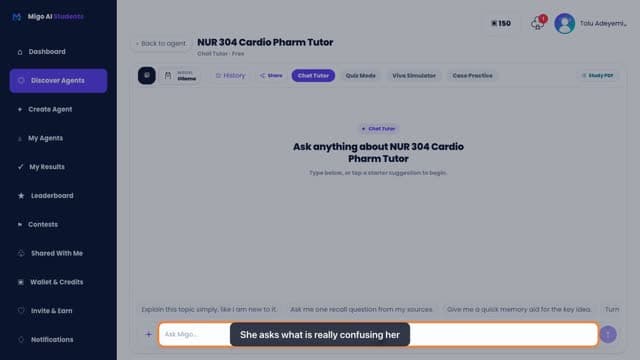
Before a lecture, upload the slides as a PDF to Study Document and ask Migo to explain each page, so you arrive knowing the outline. Afterwards, paste your notes into Notes Summarizer to turn them into a revision pack with a summary, learning objectives, flashcards and quiz prompts for your study agent. Chat Tutor can answer the question marks you left in the margin. All free. Migo works from your material, but check anything important against your lecture and reading list.
Questions
Should I take notes by hand or on a laptop?
Either can work. Handwriting tends to push you to summarise because you cannot keep up word for word, while typing is faster but makes it tempting to transcribe. If you type, deliberately paraphrase rather than copy.
Should I record lectures instead of taking notes?
A recording is a useful backup for checking things you missed, if your university allows it. It is not a replacement for notes, because rewatching a whole lecture takes as long as the lecture itself.
What if the lecturer talks too fast to keep up?
Stop trying to write everything. Catch the main point and the example, leave a gap where you lost the thread, and fill it afterwards from the slides, the recording or a classmate’s notes. Skimming the slides beforehand also helps, because you already know where the lecture is going.
Related guides
- Cornell note taking methodThe Cornell method is a note-taking layout that splits the page into three parts: a wide column for notes during the lecture, a narrow column on the left for questions or cue words added afterwards, and a short summary at the bottom. You revise by covering the notes and answering the questions in the left column.
- How to study from lecture slidesTreat lecture slides as headlines: for each slide, make sure you can explain what it means in your own words, fill in what the lecturer said around it, and test yourself on it. Reading slides alone rarely gives the full explanation.
- How to summarise lecture notesSummarise lecture notes by identifying what the lecture was trying to teach, keeping only the key ideas and how they connect, and ending with questions you can test yourself on. A good summary is much shorter than the notes and is something you can revise from.
General study advice. Follow your own course’s guidance and your institution’s rules on assessment and AI use.