
Order of an essay
The usual order of an essay is: title, introduction, body paragraphs, conclusion, then the reference list, with appendices at the very end if you have any. Inside the body, put your points in the order that best builds your argument.
What most advice leaves out
The order an essay is read in is not always the best order to write it in, and students who start at the top often get stuck on the introduction. It also helps to separate two kinds of order. The order of the parts is fixed by convention and rarely changes. The order of the points in the body is your choice, and it is where an essay becomes an argument rather than a list. That second kind of order is what markers notice. A useful test is to read only the first sentence of each body paragraph in order: if those sentences make sense as a short version of your argument, the order works. If they read like a list of separate topics, rearrange them so each point leads to the next.
Step by step
- 1
Title
Use the title or question you were given, or a clear title that names your topic and angle, plus any cover sheet your course requires.
- 2
Introduction
Brief context, your answer to the question and a short outline of how the essay will argue it.
- 3
Body paragraphs
One main point per paragraph, each opening with its point, supported by evidence, explained and linked back to the question. Order them so each builds on the last, and place counter-arguments where they can be answered.
- 4
Conclusion
Your answer restated in light of the argument, how the points fit together, and what follows from it. No new evidence.
- 5
Reference list
The full list of sources you cited, and only those, in your course’s referencing style. It starts on a new page in many courses; check your brief.
- 6
Appendices
Any extra material your brief allows, such as data tables, questionnaires or long extracts, labelled and referred to in the text. Appendices usually do not count towards the word count, but the marker may not read them closely, so nothing essential to your argument should be only there.
Common mistakes
- Ordering body paragraphs by the order you read your sources, rather than by the argument.
- Putting the counter-argument as an afterthought just before the conclusion with no response.
- Leaving the reference list off, or putting appendices before it when your course asks for the reverse.
Practise it with Migo AI Students
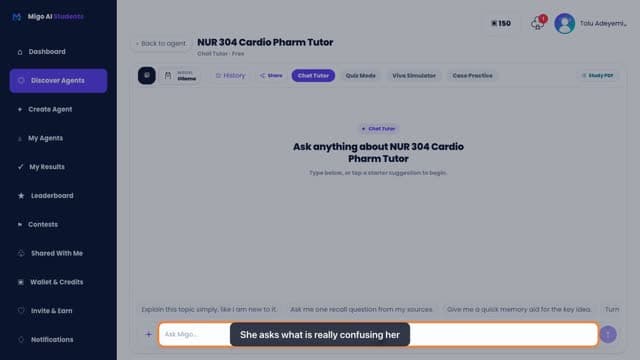
Migo does not write or reorder essays. Chat Tutor can explain what each part of an essay is for, what the command word in your question asks you to do, and help you understand the topic well enough to plan your own argument. It is free. An Assignment Mode that gives feedback on your own plan and draft against a rubric is planned but not available yet.
Questions
What order should I write an essay in?
Many students plan first, then write the body, then the conclusion, and write the final introduction last, because by then they know exactly what the essay argues.
Does an essay need headings?
Most standard essays do not, while reports and some longer assignments do. Check your assignment brief.
Where does the abstract go?
Essays usually do not have one. Dissertations and reports often do, placed after the title page and before the introduction.
Related guides
- How to structure an essayStructure an essay with an introduction that states your answer to the question, body paragraphs that each make one point supported by evidence and linked back to the question, and a conclusion that draws the points together. The argument, not the topic, should decide the order.
- How to write an essay introductionA good essay introduction gives brief context, states your answer to the question in one or two clear sentences, and outlines how the essay will argue it. It should tell the marker where you are going, not try to cover the topic itself.
- How to write a conclusion for an essayWrite an essay conclusion by restating your answer to the question in light of the argument you made, drawing your main points together to show how they support it, and saying what follows from it. Do not add new evidence or simply repeat the introduction.
General study advice. Follow your own course’s guidance and your institution’s rules on assessment and AI use.