
How to write a research proposal
A research proposal sets out the question you want to answer, why it matters, what is already known, how you will answer it, and how long it will take. Its job is to convince the reader that the question is worth asking and that your plan can realistically answer it.
What most advice leaves out
Students often treat a proposal as a short essay about an interesting topic. Supervisors and panels read it differently: they are judging whether the project is focused, original enough, ethical and possible with the time and resources you have. A proposal with a modest, clear question and a detailed method usually lands better than an ambitious one with a vague plan. The method section is where most proposals are weakest, and it is often the section readers care about most.
Step by step
- 1
Write a working title and question
State the research question in one sentence, with any aims or objectives underneath. If you cannot state it in one sentence, the project is probably not focused enough yet.
- 2
Explain the background and gap
Summarise the key literature briefly and show what is missing, contested or untested. The gap is your reason for doing the research.
- 3
Describe the method in detail
Say what data you will collect or use, from whom or where, how, and how you will analyse it. Explain why this method suits the question better than the alternatives.
- 4
Address ethics and practicalities
Note any ethical issues, such as consent or confidentiality, and how you will handle them. Mention access to participants, data or equipment, and any risks to the timeline.
- 5
Add a timeline and references
Include a realistic schedule for each stage and a reference list in the style your course uses. Check the required length and headings in your brief, as these vary.
- 6
Get feedback before you submit
Share a draft with your supervisor or tutor if your course allows it, and ask whether the question is focused enough and the method realistic. Proposals are plans, so expect to refine the question; agree any big change with your supervisor, especially if it affects ethics approval.
Common mistakes
- A question so broad it could fill several careers.
- A long literature summary with a method section of two vague sentences.
- Ignoring ethics or access, so the plan depends on data you may not be able to get.
Practise it with Migo AI Students
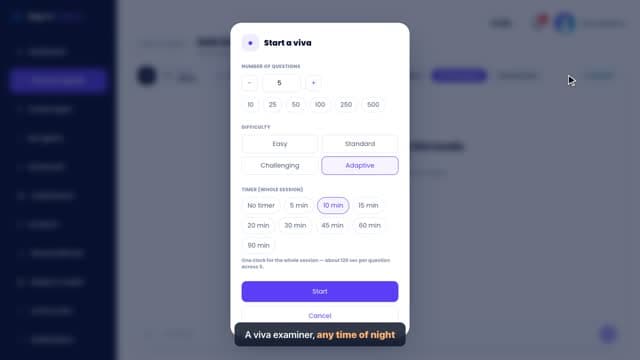
Migo does not write proposals. Chat Tutor can explain research designs and methods in plain language so you can choose and justify your own. Deep research, a Student Pro tool that uses credits, can return findings and the sources behind them on your topic, which you then read and check yourself to find the gap. If you have to present or defend the proposal, Viva Simulator can ask you the kind of questions a supervisor or panel might, such as why this method or what could go wrong, with feedback on what you missed. Chat Tutor and Viva Simulator are free.
Questions
How long is a research proposal?
It varies widely by course and level, from a page or two to several thousand words. Use the length and headings given in your brief or by your department.
Is a research proposal the same as a dissertation introduction?
No. A proposal is a plan written before the research and is often written in the future tense. Parts of it may later feed into your introduction and methodology, but they are rewritten once the work is done.
Does a research proposal need a hypothesis?
Only if your research design tests one, which is common in experimental and quantitative work. Qualitative or exploratory projects usually state a research question and aims instead. Follow your brief and your supervisor’s advice.
Related guides
- How to write a dissertation step by stepWrite a dissertation by choosing a focused research question, getting your supervisor to agree it, reviewing the literature, planning and carrying out your method (with ethics approval if needed), analysing your results, then writing the chapters and editing the whole thing against your marking criteria. Writing should start early, not after the research is finished.
- How to write a literature reviewWrite a literature review by searching systematically for research on your question, grouping what you find into themes or debates, evaluating the strengths and weaknesses of the evidence, and showing what is still unknown. It should synthesise sources, not summarise them one at a time.
- How to find sources for an essayStart with your reading list and your library’s databases, search with specific terms, follow the references of the best sources you find, and check each source is credible and relevant before you use it.
General study advice. Follow your own course’s guidance and your institution’s rules on assessment and AI use.