
How to write a dissertation step by step
Write a dissertation by choosing a focused research question, getting your supervisor to agree it, reviewing the literature, planning and carrying out your method (with ethics approval if needed), analysing your results, then writing the chapters and editing the whole thing against your marking criteria. Writing should start early, not after the research is finished.
What most advice leaves out
Dissertations rarely go wrong because the student cannot write. They go wrong because the question was too broad, the plan had no deadlines, or writing was left until the research felt “finished”, which it never quite does. A dissertation is a long project with a fixed end date, so it needs to be managed like one: a narrow question, a timeline worked backwards from the hand-in date, and chapters drafted as you go so you can see the gaps while there is still time to fill them.
Step by step
- 1
Narrow the question
Choose a topic you can answer properly in your word count and time. Turn it into a specific research question, then make it narrower. Agree it with your supervisor before going further.
- 2
Plan backwards from the deadline
Put the hand-in date at the end of a calendar and work back: final edit, full draft, analysis, data collection, ethics approval, literature review. Build in time for supervisor feedback and for things to slip.
- 3
Review the literature
Search systematically, keep structured notes on each source, and group what you find into themes. This becomes your literature review chapter and shapes your method.
- 4
Do the research
Design your method, get ethics approval if your project involves people or their data, and collect and analyse your data. Keep a record of decisions as you go; you will need them for the methodology chapter.
- 5
Draft the chapters
Most dissertations include an introduction, literature review, methodology, results or findings, discussion and conclusion, plus an abstract, references and appendices. Many people draft the methodology first and the introduction and abstract last.
- 6
Edit against the criteria
Read the full draft against your module’s marking criteria. Check that every chapter serves the research question, references are complete, and the word count and formatting rules are met.
Common mistakes
- Choosing a question so broad that it cannot be answered properly in the word count.
- Waiting until all the research is done before writing anything.
- Seeing the supervisor rarely and sending them a full draft only at the end.
Practise it with Migo AI Students
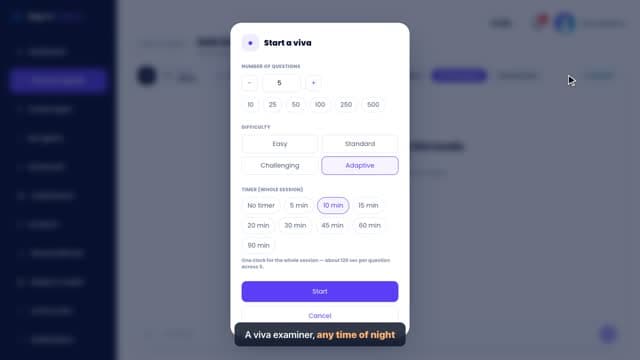
Migo will not write any part of your dissertation. It can support the reading and thinking around it. Deep research, a Student Pro tool that uses credits, searches the web on a question and returns findings with the sources it used, as a starting list you check in your library databases. Study Document lets you upload a paper as a PDF and have it explained page by page, and Chat Tutor can explain a method or statistical test you need to understand. If your dissertation has a viva or presentation, Viva Simulator can question you on your own material and give rubric feedback. Study modes are free.
Questions
How long does it take to write a dissertation?
It depends on your course, word count and type of research, so use the time your course allows as the guide. Starting the plan and literature search early matters more than the exact number of weeks.
What order should I write dissertation chapters in?
There is no fixed rule. Many students draft the literature review and methodology first, then results and discussion, and leave the introduction, conclusion and abstract until last.
Can I use AI to write my dissertation?
Submitting AI-written work as your own is usually treated as academic misconduct. Check your university’s policy; most allow far less for a dissertation than for revision.
Related guides
- How to write a research proposalA research proposal sets out the question you want to answer, why it matters, what is already known, how you will answer it, and how long it will take. Its job is to convince the reader that the question is worth asking and that your plan can realistically answer it.
- How to write a literature reviewWrite a literature review by searching systematically for research on your question, grouping what you find into themes or debates, evaluating the strengths and weaknesses of the evidence, and showing what is still unknown. It should synthesise sources, not summarise them one at a time.
- How to use AI to study without cheatingUse AI to help you learn, by explaining ideas, quizzing you and giving feedback on your understanding, and not to produce work you submit as your own. Always check your university’s and module’s rules, which differ between courses.
General study advice. Follow your own course’s guidance and your institution’s rules on assessment and AI use.