
How to write a nursing case study
Write a nursing case study by introducing an anonymised patient and their background, working through their assessment, nursing diagnosis or problems, planned care, how it was carried out and how it was evaluated, and linking each decision to evidence, guidelines and your course’s nursing model. Finish with reflection on what you learned.
What most advice leaves out
Nursing case studies are marked on clinical reasoning, not on the story of the patient. Students who write a detailed account of the admission and treatment often lose marks because they do not explain why each decision was made or what the evidence says. A good case study keeps asking “why?”: why this assessment, why this priority, why this intervention, and how do you know it worked? It also has a strict rule the essay format does not: the patient must not be identifiable anywhere.
Step by step
- 1
Protect confidentiality first
Use a pseudonym and say that you have, and remove anything that could identify the patient, the ward or the hospital. Follow your university’s confidentiality guidance and your professional code of conduct.
- 2
Introduce the patient
Give relevant background: age range, presenting problem, history and social context. Keep only what matters for the care you will discuss.
- 3
Use a structure
Work through the framework your course uses, often a nursing process such as assessment, diagnosis, planning, implementation and evaluation, or a nursing model. Use it as your headings if your brief allows.
- 4
Link care to evidence
For each problem and intervention, explain the reason and support it with current guidelines, research or policy. Discuss alternatives where relevant.
- 5
Evaluate and reflect
Say whether the care achieved its goals and how you know. End with what you learned, using a reflective model if your course asks for one.
Common mistakes
- Including details such as names, dates, ward names or rare features that could identify the patient.
- Describing the care without explaining or evidencing why it was given.
- Leaving out evaluation, so the reader never learns whether the care worked.
Practise it with Migo AI Students
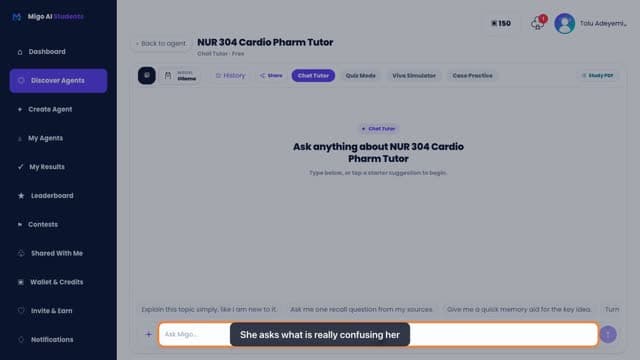
Migo will not write your case study, and you should never enter real patient details into it. What it can do is strengthen your reasoning. The official Nursing tutor, or a study agent built from your own module notes, can run Case Practice: a patient scenario where you work through history, investigations and priorities and get feedback on your reasoning. Chat Tutor explains conditions, assessments or care models you need to understand. Deep research, a Student Pro tool that uses credits, returns findings with the sources it used, which you then check and find in your library databases. Case Practice and Chat Tutor are free. For education only, not clinical advice.
Questions
Can I use a real patient for a nursing case study?
Usually yes, if your course allows it and you anonymise them completely. Some courses require consent or permission; follow your module’s guidance.
Which nursing model should I use?
Use the one your course teaches or your brief names. Choosing a model that fits the patient’s needs, and saying why, is better than naming one without applying it.
Should a nursing case study be in the first or third person?
It varies by course. Many case studies describe the patient and care in the third person and switch to the first person for the reflective section. Follow your brief.
Related guides
- Gibbs reflective cycleGibbs’ reflective cycle is a six-stage model for reflecting on an experience: Description, Feelings, Evaluation, Analysis, Conclusion and Action plan. It moves you from what happened to why it happened and what you will do differently next time. It was developed by Graham Gibbs and is widely used in nursing, health and education courses.
- How to answer case study questionsAnswer a case study question by identifying the central problem, choosing the theory or framework from your course that fits it, applying that framework to the specific details of the case, and ending with a justified recommendation or conclusion.
- How to study for nursing examsStudy for nursing exams by testing yourself on the core content with questions and flashcards, practising scenario questions that ask you to apply knowledge to a patient, keeping drug calculations sharp with regular practice, and preparing for practical exams such as OSCEs separately and hands-on.
General study advice. Follow your own course’s guidance and your institution’s rules on assessment and AI use.