
How to study for nursing exams
Study for nursing exams by testing yourself on the core content with questions and flashcards, practising scenario questions that ask you to apply knowledge to a patient, keeping drug calculations sharp with regular practice, and preparing for practical exams such as OSCEs separately and hands-on.
What most advice leaves out
Nursing exams test several different skills at once: factual knowledge of anatomy, physiology and pharmacology; applying that knowledge to prioritise care for a patient; accurate drug calculations; and, in practical exams, carrying out skills while communicating. Revising only by reading notes covers the first skill weakly and the others not at all. A good nursing revision plan gives each skill its own kind of practice, fitted around placement shifts.
Step by step
- 1
Map the exams
List each exam, its format (multiple choice, short answer, calculations, OSCE) and its date. Each format needs different practice.
- 2
Test yourself on core content
Turn anatomy, physiology, pharmacology and condition topics into questions and flashcards, and answer them from memory, revisiting weak ones often.
- 3
Practise application questions
Many nursing questions give a patient scenario and ask what you would do first or why. Practise these and read the rationale for every answer, including the ones you got right.
- 4
Do calculations little and often
Practise drug calculations regularly in short sessions, showing your working, rather than in one block before the exam.
- 5
Prepare practical exams hands-on
For OSCEs and skills assessments, practise with classmates in timed conditions and talk through what you are doing and why.
- 6
Plan around placement
Use short sessions on placement days, such as flashcards on a break, and keep longer sessions for days off. Link what you see on placement back to your theory.
Common mistakes
- Rereading lecture notes as the main revision method.
- Leaving drug calculations until the week before the exam.
- Practising questions without reading the rationales, so the same mistakes repeat.
Practise it with Migo AI Students
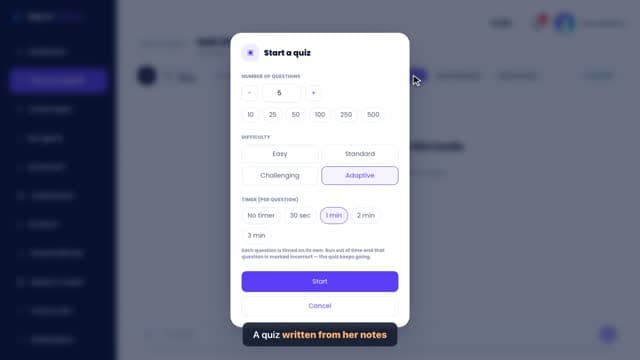
The official Nursing tutor is ready to use, or you can build a study agent from your own module notes. Quiz Mode runs timed questions with a rationale for each after you submit, Case Practice works through patient scenarios and gives feedback on your reasoning and priorities, Flashcards keeps weak topics in your review loop, and Exam Simulator mixes question types into a timed session with a weak-topic report. All are free. Migo cannot replace hands-on OSCE practice, and it is for education only, not clinical advice.
Questions
How do I answer “what would you do first” nursing questions?
Use the prioritisation framework your course teaches, often starting with airway, breathing and circulation and immediate safety, then check each option against it. Practising many such questions with rationales builds the habit.
How can I revise while on placement?
Use short, regular sessions such as flashcards or a few questions on breaks, and connect what you see on shift to your theory. Save longer revision for days off.
How do I get better at drug calculations?
Learn the formula and unit conversions your course teaches, always write out your working and check units, and practise a few questions often rather than many at once. Sense-check each answer: does the dose look reasonable?
Related guides
- How to prepare for an OSCEPrepare for an OSCE by practising each station type in timed, realistic conditions with someone observing, and by rehearsing how you explain your reasoning out loud. Practical skills need hands-on practice; the talking and thinking parts can also be practised on your own.
- How to answer multiple choice questionsRead the question and try to answer it before looking at the options, then eliminate the options you know are wrong and choose from what is left. Practise with explanations so you learn why each wrong option is wrong, not just which one is right.
- How to study pharmacologyStudy pharmacology by learning drug classes rather than individual drugs: for each class, learn the mechanism of action first, then the main uses, side effects, interactions and cautions that follow from it. Test yourself with flashcards and questions, and keep coming back to each class over time.
General study advice. Follow your own course’s guidance and your institution’s rules on assessment and AI use.