
How to study pharmacology
Study pharmacology by learning drug classes rather than individual drugs: for each class, learn the mechanism of action first, then the main uses, side effects, interactions and cautions that follow from it. Test yourself with flashcards and questions, and keep coming back to each class over time.
What most advice leaves out
Pharmacology feels overwhelming because students treat it as a list of hundreds of drug names to memorise one by one. Most of the useful information is shared across a class, and much of it follows logically from the mechanism. If you know how a class works, many of its effects, side effects and interactions make sense rather than needing to be memorised. Learning the mechanism first turns a list into a system, and it also helps with application questions that ask what would happen in a scenario.
Step by step
- 1
Organise by class
Group drugs into classes, and classes into body systems. Learn one or two example drugs per class well, including any naming patterns your course points out.
- 2
Start with the mechanism
For each class, make sure you can explain how it works: what it acts on and what that does. Draw it if it helps.
- 3
Derive the rest
From the mechanism, work out the uses, common side effects and important interactions, then check against your notes. Learn separately anything that does not follow.
- 4
Test yourself daily
Use flashcards with one question each, such as the mechanism of a class or a key side effect, and review weak cards more often.
- 5
Practise application
Answer scenario questions: a patient on this drug develops this symptom, why? Exams often test application, not just recall.
- 6
Keep drug calculations separate
If your course includes dosage calculations, practise them on their own regularly. They are a different skill from pharmacology knowledge.
Common mistakes
- Memorising drugs one by one without grouping them into classes.
- Learning side effects as a list without understanding the mechanism behind them.
- Cramming pharmacology just before the exam instead of revisiting it over weeks.
Practise it with Migo AI Students
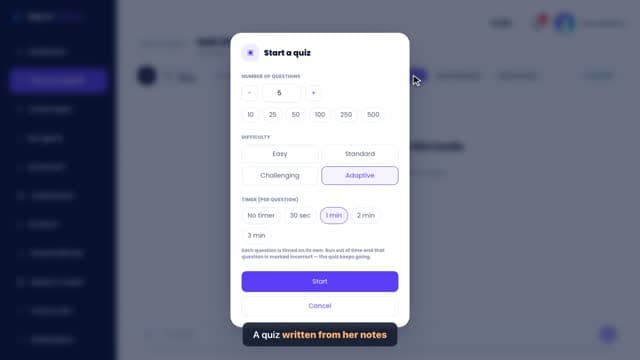
Start with the official Pharmacy, Nursing or Medicine tutor, or build a study agent from your own lecture notes so the questions match your course. Chat Tutor explains a mechanism step by step and checks you understood it, Flashcards keeps weak cards in your spaced review loop, and Quiz Mode runs timed questions with explanations. Those modes are free. Student Pro adds a diagram tool, metered by credits, that can draw a labelled diagram of a mechanism for you to study and redraw. For education only, not prescribing or clinical advice.
Questions
What is the easiest way to remember drug names?
Learn classes and any shared naming patterns your course highlights, then attach each drug to its class. Test yourself regularly rather than rereading lists.
How do I learn drug side effects?
Link each side effect to the mechanism of the class where you can, so it makes sense. Use flashcards for the ones that do not follow from the mechanism.
Should I learn generic or brand names?
Most courses teach and examine generic names, because brands vary between countries and manufacturers. Follow what your course and its exams use.
Related guides
- How to make flashcards that actually helpMake each flashcard ask one clear question with one short answer, write it so you have to recall the answer rather than recognise it, and review the cards you get wrong more often than the ones you know.
- What is active recall?Active recall is studying by retrieving information from memory, for example by answering questions with your notes closed, rather than by reading the information again. Each act of retrieval strengthens the memory and shows you what you have not learned yet.
- How to study for nursing examsStudy for nursing exams by testing yourself on the core content with questions and flashcards, practising scenario questions that ask you to apply knowledge to a patient, keeping drug calculations sharp with regular practice, and preparing for practical exams such as OSCEs separately and hands-on.
General study advice. Follow your own course’s guidance and your institution’s rules on assessment and AI use.