
How to answer short answer questions
Answer a short answer question by checking the command word and the marks available, then giving exactly what is asked: one clear, specific point for roughly each mark, using correct terms, with no padding. The marks tell you how much to write.
What most advice leaves out
Short answer questions are often marked against a list of expected points. That means two things students miss. First, extra writing does not earn extra marks once the points are covered; it only costs time. Second, a vague answer that hints at the right idea may not match the point on the mark scheme. Precise terms, specific examples and one point per mark are what turn half-right answers into full marks. Short answer papers also tend to have many questions, so time matters more than in an essay paper: a student who writes a page for every two-mark question will run out of time before the end, and the unanswered questions at the back cost far more than any extra detail earned.
Step by step
- 1
Check the marks
Use the marks as a guide to length. A two-mark question usually needs two distinct points or one point with an explanation; a six-mark question needs more.
- 2
Answer the command word
“State” or “name” needs a short fact. “Describe” needs what happens. “Explain” needs why or how. “Compare” needs similarities and differences side by side.
- 3
Lead with the answer
Put the direct answer in your first sentence. Do not restate the question or write an introduction.
- 4
Be specific
Use the correct technical terms from your course, and give a precise example or value where it helps. Vague wording often misses the mark.
- 5
Keep to time
Work out roughly how long each mark is worth, from the length of the paper and the total marks, and move on when a question has had its share. Mark any you skip and come back at the end.
- 6
Practise against mark schemes
When revising, compare your answers with mark schemes or model answers and note which points you missed, then practise those.
Common mistakes
- Writing a paragraph for a one-mark question.
- Describing when the question says explain, so the “why” is missing.
- Using everyday words where the mark scheme expects a technical term.
Practise it with Migo AI Students
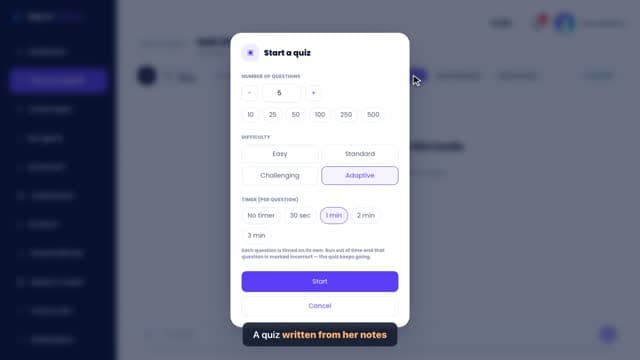
Exam Simulator combines multiple-choice and short answer questions from your study agent’s sources into a timed session, with review and a weak-topic report afterwards. Quiz Mode gives explanations after you submit, and Flashcards helps you learn the exact definitions and terms short answers depend on, keeping weak cards in your review loop. All three are free.
Questions
How long should a short answer be?
Let the marks decide. A rough guide is one clear point per mark, but follow any guidance your course gives on length.
Can I use bullet points in short answer questions?
Sometimes, for “list” or “state” questions, but “explain” and “discuss” questions usually need full sentences. Check your exam instructions.
What if I do not know the answer to a short answer question?
Write what you do know that is relevant, using correct terms, rather than leaving it blank, unless your exam penalises wrong answers. Partial answers can still earn some marks.
Related guides
- How to answer multiple choice questionsRead the question and try to answer it before looking at the options, then eliminate the options you know are wrong and choose from what is left. Practise with explanations so you learn why each wrong option is wrong, not just which one is right.
- How to use past papers to reviseUse past papers as practice under real exam conditions, mark them honestly, and then revise the specific things you got wrong before attempting another. A past paper is most valuable as a diagnosis, not just a score.
- How to answer essay questions in examsAnswer an exam essay question by reading it carefully for the command word and topic, spending a few minutes on a short plan with your answer and main points, then writing a focused essay that argues that answer with evidence, within the time you have allowed for it.
General study advice. Follow your own course’s guidance and your institution’s rules on assessment and AI use.