
Blurting method of studying
Blurting is a revision method where you study a topic, close your notes, and write down everything you can remember about it on a blank page as fast as you can. You then check against your notes, fill in what you missed in a different colour, and focus your next session on those gaps.
What most advice leaves out
Blurting is popular because it is simple and needs only a pen and paper. It is a form of active recall: the page shows exactly what you can produce from memory and what you cannot. Where it goes wrong is in the checking. Students blurt, glance at their notes, feel they "basically knew it" and move on. The missed points, written in a second colour, are the whole output of the exercise, and they need to be blurted again later to count. Blurting also works best on a topic small enough to finish in one go. A blurt of a whole module ends up as a scattered list that is hard to check and easy to give up on.
Step by step
- 1
Pick a small topic
Choose one sub-topic or one section of a specification, not a whole module. A topic you can blurt in five to ten minutes is the right size.
- 2
Study it briefly
Read through your notes or textbook on that topic once, with attention. Do not try to memorise it all at this stage.
- 3
Close everything and blurt
On a blank page, write everything you remember: facts, definitions, diagrams, examples, links. Do not stop to check. Messy is fine.
- 4
Check and fill gaps in another colour
Open your notes and go through them line by line. Add anything you missed or got wrong in a different colour, so the gaps stand out.
- 5
Blurt the same topic again later
A day or two later, blurt the topic again from scratch. The aim is for the second colour to shrink each time.
Common mistakes
- Peeking at notes halfway through the blurt.
- Checking loosely and not writing in the missed points.
- Blurting a topic once and never coming back to it.
Practise it with Migo AI Students
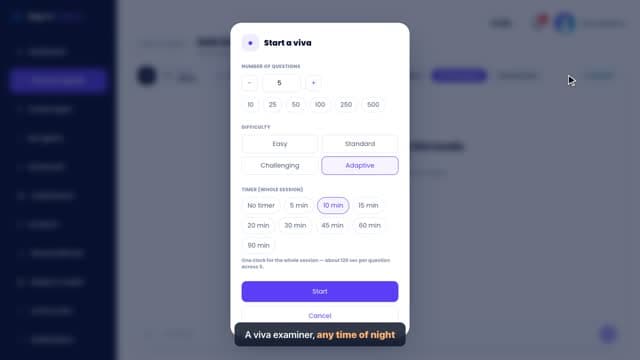
You can do the checking step with Migo. Type your blurt into Chat Tutor and ask it to compare it with your study agent’s sources and point out what you left out or got wrong, then have it explain those points. Viva Simulator is a spoken-style version of the same idea: it asks an examiner question and gives rubric feedback listing the points you missed. Turn the missed points into Flashcards so they come back in your review loop. All free. Always check the feedback against your own notes.
Questions
Is blurting the same as active recall?
Blurting is one form of active recall. It works the same way, by pulling information from memory, but in a free-form brain dump rather than answering specific questions.
Should I blurt by writing or out loud?
Writing gives you a page to check against your notes, which is the main point. Blurting out loud can work for quick reviews, but it is harder to see exactly what you missed.
How long should a blurt take?
Long enough to empty your head on the topic, often five to ten minutes for a small sub-topic, plus the time to check it carefully. If a blurt runs much longer, the topic is probably too big and worth splitting.
Related guides
- What is active recall?Active recall is studying by retrieving information from memory, for example by answering questions with your notes closed, rather than by reading the information again. Each act of retrieval strengthens the memory and shows you what you have not learned yet.
- How to memorize fastTo memorise something fast, first make sense of it, break it into small chunks, then test yourself on each chunk from memory instead of rereading, and come back to it a few times over the next days. Memorising quickly is mostly about recalling early and often, not about reading it more times.
- What is spaced repetition and how do you use it?Spaced repetition is reviewing material at increasing intervals over time, with more frequent reviews for the things you find hard and less frequent ones for the things you know. It makes memories last longer than reviewing the same amount in one block.
- How to make revision notesMake revision notes that are short, organised by the questions you might be asked, and built so you can test yourself from them. Then spend most of your revision time using the notes, not making them.
General study advice. Follow your own course’s guidance and your institution’s rules on assessment and AI use.